
Artist Karen Chadwick transforms Florida’s fragile waterways into vivid reflections of life, loss and resilience.
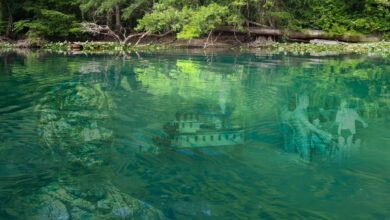
Karen Chadwick drifts quietly across the water of Lake Ocklawaha, camera in hand, eyes tracing the ghostly silhouettes of broken cypress stumps rising from the Rodman Reservoir. Sunlight glints off the ripples; birds shift from branch to branch. For a moment, everything is still. She lifts her lens, capturing a fleeting angle, a ray of light that pierces the silent history lying beneath the surface.
Later, in her studio, she returns to these photographs, studying compositions, shapes and the subtle gestures of life. From them, she creates paintings that carry the weight of what language cannot: the quiet return of life to a place once lost — the stubborn insistence of the natural world.
For Chadwick, this way of seeing began long before she held a camera. Growing up in Sarasota, she preferred the woods to the classroom. She climbed treehouses, wandered palmetto-lined paths and spent hours pressed to windows, daydreaming about the world beyond the walls. The outdoors, she says, was the true babysitter of her childhood — where she learned to pause and notice how fauna and flora reveal themselves only in stillness and through the careful, deliberate movements of creatures flying, swimming or crawling.
At age 66, nature remains both her refuge and her muse. Whether photographing wildlife, leading river tours across north-central Florida or simply absorbing the beauty beyond closed doors, Chadwick continues to learn from the world she has loved since childhood.
Her lifelong observation of nature also fuels her activism. For more than three decades, she has been closely involved with the Rodman Reservoir, grappling with the aftermath of a dam that flooded thousands of acres and altered an entire ecosystem. Since then, she has devoted her life to documenting what was destroyed, bearing witness through art and bringing people face-to-face with the consequences of treating nature as expendable.
“The other day someone said the dam looked like purgatory,” Chadwick recalls from a recent tour. “People usually get quiet when we pass by. It’s millions of trees that were killed, all broken off at the same height. It’s the cypress graveyard, as we call it — but the birds and the life are returning.”
From her visits to the reservoir, she began noticing fish species that could no longer pass the dam — species once common in Silver Springs and the Silver River. Back in her studio, her photographs as a guide, she created a series of paintings depicting these fish and their behaviors, each piece functioning as both documentation and protest.
During a recent exhibition at the Brick City Center for the Arts in Ocala, she unveiled a haunting painting of an eagle perched on a half-cut, dead branch in the reservoir. “It’s stark imagery of the drowned cypress swamp,” she says. “The eagle is just perched there — not in defiance, just in existence.”
From a young age, Chadwick was drawn to observation and creation. She wandered freely through the Ringling Museum as a child, captivated by the artwork around her, while an illustrated book about nature, sent by her aunt from Europe in the 1960s, cemented her desire to capture the world she saw. “I thought, ‘I want to do that. I want to draw nature,’” she recalls. And she has done exactly that — painting the many birds, fish and landscapes she’s encountered along the way.
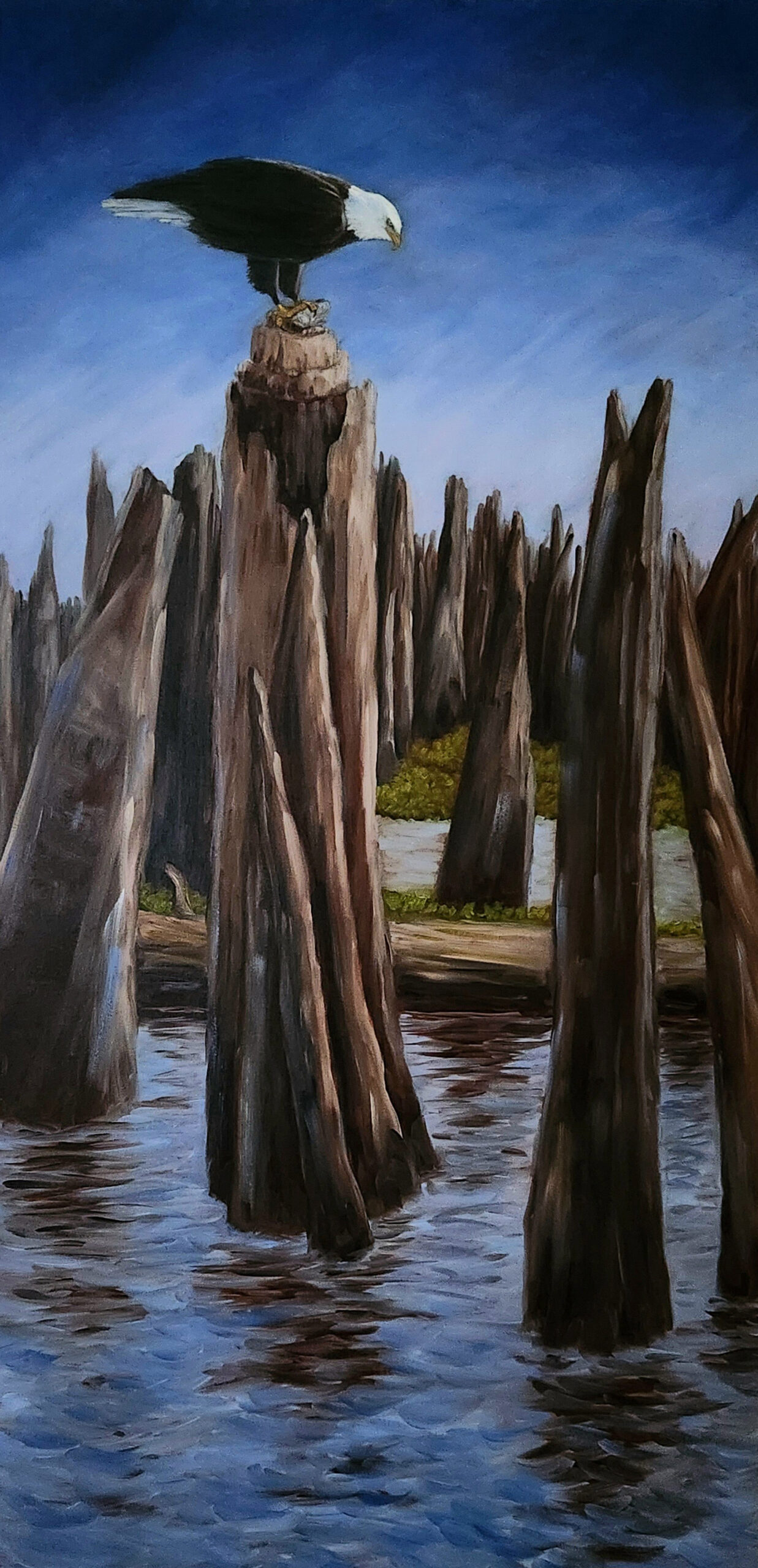
“It’s stark imagery of the drowned cypress swamp. The eagle is just perched there — not in defiance, just in existence.”
—Karen Chadwick
By age eight, she was already imagining the life she wanted to lead. Two paths appeared before her: dig into the past as an archaeologist or shape the world as an artist. “If I’m an archaeologist,” she remembers thinking, “I’ll be finding what other people made. But if I’m an artist, somebody will be finding what I make someday.”
In many ways, she became both, taking on multiple roles and careers simultaneously, never committing to just one path, driven by a desire to keep learning and venturing into the unknown. “My whole life I’ve just been taking the path of least resistance, taking jobs that I find interesting, that kind of present themselves,” she says, citing her move to Ocala in the 1990s to work on exhibits at the Silver River Museum. “While I was doing that, I got my captain’s license, and I’ve been leading river tours ever since.”
Her fascination with nature extended even further. Fossils captivated her curiosity, and she began reconstructing fragmented specimens — a discipline requiring meticulous sculpting skills she honed through her painting and sculpture degree at the Ringling School of Art and Design after high school. Each skill, each exploration, became another way of seeing, understanding and shaping the natural world she had long admired.
“When I create a painting or sculpture,” she says, “it makes me feel like I am part of the place, even when my presence is irrelevant to the continuation of the subject’s existence.”
Beyond her studio in Gainesville, Chadwick channels her passion into conservation, working with organizations such as St. Johns Riverkeeper, Reunite the Rivers and Florida Wildlife Conservation. The work, she says, is about helping people notice — and reminding them that involvement doesn’t require expertise, only attention.
“Conservation groups monitor legislation and alert people,” she explains. “It’s easier now to know what’s happening. Maybe you’re working full time, caring for kids or an elderly parent and don’t have the bandwidth to track these issues. These organizations give you a heads-up — action alerts anyone can respond to.”
Decisions that once happened quietly are now more visible, and participation, she believes, is more accessible than ever. “If you care about the health of the water, the air and the land,” Chadwick says, “you have to get involved.”
It is the same impulse that guides her art and her time on the river: to slow down, to look closely and to bear witness. Through paint, photography and presence, Chadwick ensures that what remains — fragile, altered but still alive — is seen, remembered and protected.