
Silver Springs– 250 Years of America 10,000 Years of History.
Before Ocala was Ocala, before Florida was a state, and before the Declaration of Independence was signed, people were gathering at Silver Springs.
Since the beginning, people have been coming to this river. We know because of what they left behind. This summer, as the country marks 250 years, Ocala has a longer story to tell.
Marion County’s history didn’t begin in 1776. It didn’t begin with statehood, or with the founding of Ocala, or even with the arrival of European explorers. It began at the water, with people whose names we mostly don’t know.
The First People
Stand at Silver Springs on a still morning and listen. You can hear the dragonflies. A fish breaking the surface. The water still and clear in the morning light. The people who first found this place felt the same thing.
They made camp, hunted the surrounding forests, and breathed the same crisp cypress air that hangs over the river today. They left behind stone points and scrapers — in 1895, a dig turned up pottery, axes, and arrowheads from a settlement that once inhabited this ground.
Generations of people moved through this land. Around 1,000 years ago, one group made it their own.
The Timucua settled along the Silver River and considered the springs a sacred shrine — a place connected to their water god. The name of their province, Ocali, meaning “Big Hammock” or “abundant place,” would eventually become the name of the city built on the same ground. Ocala. The city carries their name.
When Hernando de Soto’s expedition moved through in 1539, the Timucua numbered an estimated 200,000 people across northern and central Florida. Within only 150 years, that number would fall to fewer than 1,000. Diseases came first — smallpox and measles moved quickly through the population. Then came the raids from the English colonies to the north, and with them more warfare and forced displacement. Not through any single defeat — through disease, raids, and time. By the mid-1700s, the Timucua were gone, yet the springs kept flowing.
The Seminole
The Seminole were originally Creek — part of a confederacy of nations in Georgia and Alabama who, over the late 1700s, began migrating south into the open lands of Florida. They came for the same reasons everyone before them had: the water, the game, the land. The name Seminole is thought to derive from the Spanish cimarrón — a word meaning “runaway” or “wild one.” They wore it as a title.
They built their villages throughout what is now Marion County. The Silver River was their life source. They fished its waters, drank from its springs, and built their daily rhythms around it. Their villages sat close to the water. They knew which bends in the river held fish, which hammocks held game. Children grew up on the same banks their grandparents had fished. This was not temporary. This was home.
On October 23, 1834, a Seminole delegation gathered near Silver Springs at the request of U.S. government officials who wanted to discuss one thing: removal. Under the Indian Removal Act of 1830, the federal government had decided the Seminole needed to leave Florida — leave the water, leave the hammocks, leave everything — and relocate west to Indian Territory.
To the Seminole, the government wasn’t just asking them to leave the river. They were being asked to leave home. Peace. Something sacred.
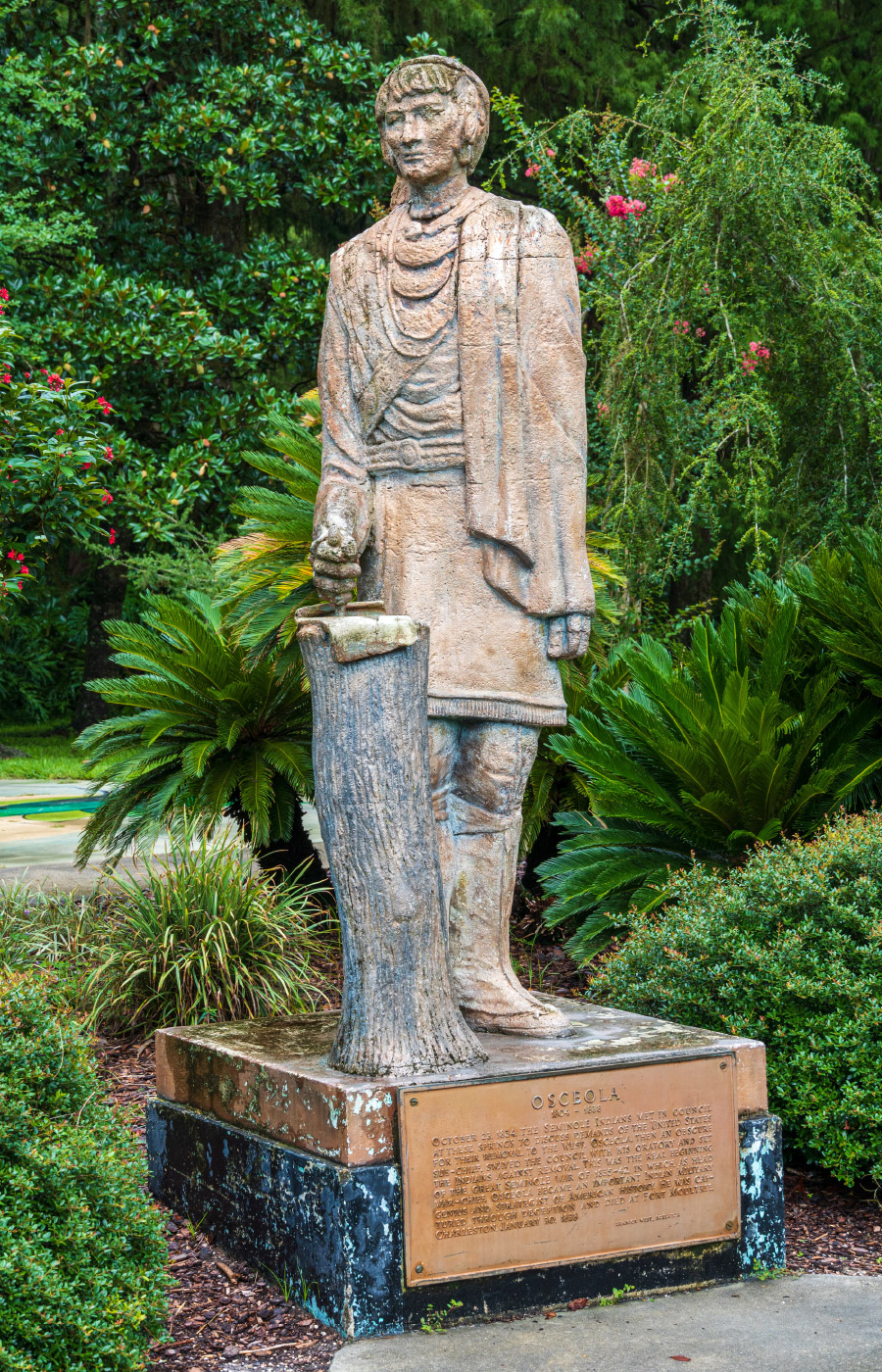
A young warrior named Osceola stood before the council. He was not there to negotiate — the Seminole were not leaving. Then, according to some accounts of the day, he drew his knife and drove it through the removal treaty lying on the table. “This is the only treaty I will ever make with the whites,” he reportedly said.
That act ignited what would become the longest and most costly Indian war in American history. On December 28, 1835, Osceola’s warriors assassinated U.S. Indian Agent Wiley Thompson at Fort King. That same day, roughly 180 Seminole warriors ambushed a column of U.S. soldiers marching through the woods to the south. More than 100 soldiers were killed. The Second Seminole War had begun.
It lasted seven years and cost the United States an estimated $30 to $40 million — more than any previous conflict fought on American soil. Roughly 1,500 American soldiers lost their lives. The number of Seminole casualties was never officially counted. By 1842, most of the Seminole population had been loaded onto ships and forced from the river — west to Oklahoma. Florida’s chapter of the Trail of Tears. A few hundred Seminole refused to surrender. They disappeared into the Everglades. Their descendants became the Seminole Tribe of Florida, who are still here today. They are one of the only tribes in American history that never signed a peace treaty with the United States. They simply refused.
Fort King and the Making of Ocala
In 1827, the U.S. Army established Fort King on high ground in the middle of Seminole territory: a watch post, built to patrol the line between Native lands to the south and American settlers pushing in from the north. It was built on conflict. For seven years, the fort was the center of the war. Soldiers arrived and sometimes didn’t come back. Supply wagons rolled in from the coast. Dispatches were written and sent to Washington. The Seminole knew this land. They knew which swamps couldn’t be crossed, which hammocks offered cover, which trails through the palmetto led nowhere. The U.S. military did not. At the war’s peak, several hundred men were stationed within the fort’s walls, living on high ground in the middle of the war. Miles to the east, the springs kept running.
After the Seminole Wars ended, Ocala took shape on the same ground — built even from the same materials. The first courthouse was made from the timber of the old fort. Settlers arrived, and new streets were cut through the same ground where soldiers had stood watch. Then, in 1889, came the boom: farmers found phosphate in the ground — ancient rock deposits left behind by a sea that once covered this land. The railroad followed. New businesses, new people. By 1890, it was the fifth-largest city in Florida, home to nearly 3,000 people.
Through it all, the springs kept flowing.
Anyone who comes here can feel what others have felt at this river for thousands of years. The same stillness the Timucua knew. The same pull the Seminole fought to keep. The same water that stopped Hollywood in its tracks.
Silver Springs Finds Its Audience
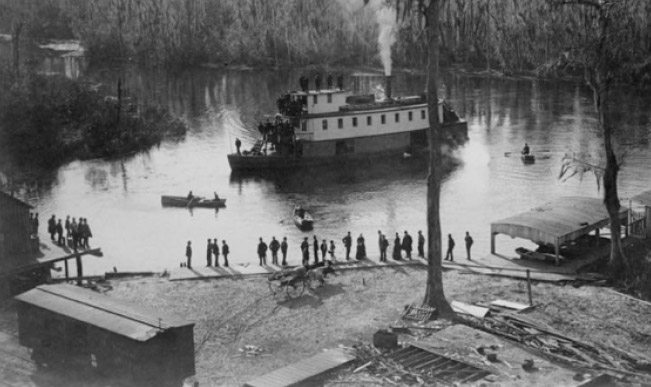
By the late 1870s, a man named Hullam Jones had an idea. Tourists were already making their way to Silver Springs by steamboat — the water was famous, the clarity almost unbelievable. Jones built a boat with a glass bottom. Through the glass, the river opened up — fish moving through the river grass, a turtle resting on the white sand floor, spring vents quietly bubbling up from the limestone. A whole other world on the other side of the glass. By 1878, glass-bottom boat tours were a formal operation, and Silver Springs had quietly become Florida’s first tourist attraction. Word spread fast. By the 1880s, visitors were arriving from across the country. At a time when there was no scuba gear, no underwater cameras, no way to see beneath the surface of any river, visitors could stand on a boat at Silver Springs and look straight down thirty feet to the white sand floor. People had never seen anything like it.
Hollywood discovered it next. A river people had called home for thousands of years was now a movie set. The riverbanks were lined with film crews and lighting. Tarzan swam here in the 1930s. Creature from the Black Lagoon haunted these waters in the 1950s. Over the decades, more than 22 movies and television productions have been filmed at Silver Springs.
The springs that had drawn people here since the beginning were now drawing movie stars.
Marion County in 2026
Today, nearly 422,000 people call Marion County home — and anyone who comes here can feel what others have felt at this river for thousands of years. The same stillness the Timucua knew. The same pull the Seminole fought to keep. The same water that stopped Hollywood in its tracks.
All of it is still here. Fort King is a National Historic Landmark, preserved on the east side of town. The Seminole Tribe of Florida holds their sovereignty and their story. Silver Springs is a state park, the glass-bottom boats still running, the water clear as ever.
This summer, as America marks 250 years, stand at the edge of the springs on a still morning. The dragonflies are out. A fish breaks the surface. The water rises up from the limestone with force — cold and ancient, the same way it always has.