
The work behind the music of Zac Petty.
I hadn’t planned on finding a story. I stopped to listen, expecting to stay for a song or two. Three hours later, I was still there. It wasn’t just the music that stayed with me. It was the question that followed: Who is the person behind the performance?
Before sitting down with Zac Petty, I never gave much thought to what happens beyond the stage. Like many people, I simply enjoyed the live music. It wasn’t until we talked that I realized how much of an artist’s journey remains unseen: the years of preparation, the balancing act between creating original work and performing the familiar songs audiences love, and the countless hours that go into building a life in music.
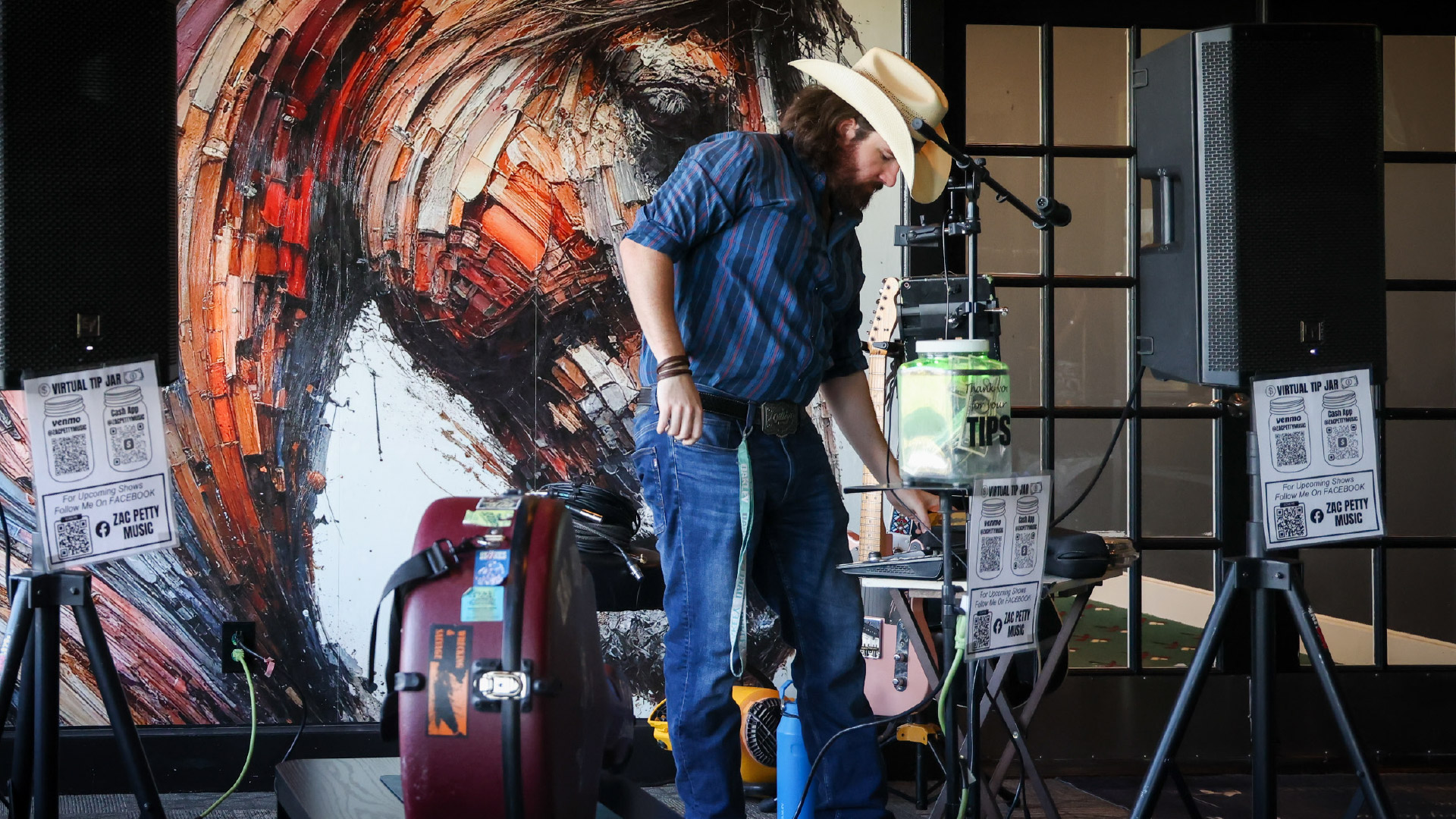
Raised in Chiefland, Florida, Petty has become a familiar face across Marion County, performing at local venues while steadily building a reputation as a respected working musician. At 29, he performs roughly 200 shows a year, often five nights a week.
The guitar entered his life when he was 12. “My dad just decided for me that I was going to learn how to play the guitar,” Petty said. “It was a whole new world that I didn’t know existed.”
From that point forward, music became central to nearly everything he did. He played sports in high school but admits he would sometimes skip football practice to play guitar with an accomplished musician nearby. He grew up in a Christian household and began playing in church, where his father was cautious about the rock music that increasingly captured his attention.
His influences would eventually stretch across genres. He listened to Peter Frampton’s “Frampton Comes Alive!” nearly every day for several years after an uncle burned him a copy. He studied the work of guitarists including Phil X, Slash, Joe Bonamassa, John Mayer, Steve Vai and José Feliciano. He gravitated not only toward music he enjoyed, but toward music that challenged him. “I like stuff that’s technically challenging,” he said. “I’m a musician. I don’t listen to stuff just for enjoyment.”
That drive to keep learning shaped his early career. Before stepping forward as a solo artist and songwriter, Petty worked as what musicians call a hired gun, a player brought in to perform with other artists, join bands for particular shows and play on recordings.
One performance demonstrated just how demanding the job can be; he was asked to learn 47 songs in three days for a New Year’s Eve performance. When the final set list arrived, it included another group of songs he had not been given.
He had only hours to learn the additional material before making a six-hour drive to the show.
“You’re locking yourself in a room and being a nervous wreck for three days,” he said. “You don’t even have time to eat hardly because you have to learn all these ridiculous songs.”
The job paid $800, plus tips. After the performance, he packed up around 1 a.m., drove six hours home and spent the next few days recovering. “You’re like, ‘I’m never doing that again,’ until you get offered another $800,” he said. “It’s a cycle.”
Years of those experiences taught him how to chart songs, creating what he describes as a road map of the chords, changes and structure. With a digital page turner at his feet, he can follow those charts while performing, sometimes learning the finer details of a song while he is already playing it for an audience.
Preparation, he believes, is what creates opportunity. “The more prepared and adept you are, the more gigs you’ll get,” he said.
That preparation is also what allows him to move between roles. He can lead a solo show, accompany another singer, step into a band or play guitar on a recording. Although audiences know him as a singer-songwriter, he is equally comfortable stepping into a supporting role with another artist.
When he performs alone, however, Petty sees his responsibility as something larger than playing the right chords and singing the right lyrics.
“My job is not to play music,” he said. “My job is to take over the room and direct everyone to have a good time.”
That ability did not come naturally. Petty describes himself as painfully shy when he was younger. Music pushed him to stand in front of people, interact with strangers and eventually command a crowd.
“I was such an introvert before I started playing music, and now I’m the polar opposite,” he said. “It allowed me to be in front of people and be OK.”
It also taught him that musicians cannot expect an audience to care simply because they have talent. They have to give people a reason to pay attention.
Petty knows that perspective can seem harsh.
“That sounds cynical, but until someone is famous, people don’t know that they care about them,” he said. “You have to give them a reason.”
For Petty, that means thinking beyond the music. It means understanding the business, learning how to market himself and recognizing what an audience needs from a performance.
“You have to be a non-artsy person to be good at marketing,” he said. “You have to be a non-artsy person to be able to get people to pay attention.”
But when it comes to songwriting, Petty shifts into a different mindset. Rather than waiting for one sweeping moment of inspiration, Petty often begins with something small: a funny observation, an insignificant detail, a moment of heartbreak or a phrase that catches his attention.
“My job is not to play music. My job is to take over the room and direct everyone to have a good time.”
“I look at the little insignificant, silly things in life,” he said. “Sometimes they can be really moving.”
He does not believe in forcing a song. Even when he is the one writing it, he describes the process as receiving something rather than manufacturing it.
“These songs come from nothingness and then become something,” he said.
He also thinks carefully about what makes a song connect. A strong song, he believes, needs multiple moments that pull a listener in, whether through lyrics, rhythm, repetition or an unexpected musical change.
Although he performs a broad repertoire to meet the needs of the room, Petty describes his own sound as Southern rock, with elements of country and folk. His longer-term goal is to release an album of original music, something he has been working toward since around 2017.
The cost to record it, he estimates, is approximately $7,900.
What he already has is a network of musicians he has met through years of playing on other people’s records. He has guitarists, drummers, keyboard players and other professionals he believes can help bring the songs to life.
“I’ve got all these people who want to play on my records,” he said. “I just have to say, ‘Here are the songs,’ and they’re going to be like, ‘OK, let’s make you sound like a million bucks.’”
Until that album exists, Petty believes certain opportunities remain just out of reach, not because they aren’t available, but because he wants to make the most of them. He has opened for nationally known artists and built relationships with musicians he could potentially tour or perform with again. But without original music available for listeners to discover afterward, there is little for new fans to connect with or for him to build upon.
“I’ve got a lot of opportunities that are just waiting,” he said. “They’re ready to take off like a rocket as soon as I have an album out.”
Still, Petty does not speak as though he has arrived. Instead, one of the clearest themes running through our conversation was his desire to remain uncomfortable.
“You always want to be the least good musician in the room,” he said. “You want to get around people where you are the worst musician in the room. That is when you’ll get better every single time.”
He believes time alone does not make someone better. A musician can play for decades and still repeat the same year of experience over and over if they never challenge themselves.
“If you’re not consistently being uncomfortable, then you’re not learning anything,” he said. “When you’re complacent, you’re wasting your life and your time.”
That pursuit has required sacrifice.
Petty says the demands of performing have affected relationships and influenced his decision to wait before having children. With a schedule built around hundreds of shows, rehearsals and travel, he does not believe he could give a family the attention it would deserve right now.
“I’ve been in relationships before where they wanted me to choose between them and the music,” he said. “People don’t get to touch my dreams anymore.”
His devotion to performing has also challenged his health.
Petty was hospitalized for a week with myocarditis, an inflammation of the heart muscle. He said the damage was severe and that, at one point, he could barely walk. Yet two days after leaving the hospital, he traveled to perform at events in New Jersey and New York.
“When I stood up out of the hospital bed, my heart did a jump,” he recalled. “I was like, ‘Oh, that’s a weird feeling. I should not have gone.’”
He now recognizes the danger in the mentality that pushed him back onstage so quickly.
“I had this weird mentality of the show must go on, and it almost killed me,” he said.
The experience did not lessen his love for music, but it gave new weight to a phrase he had used casually before.
“I’ve told people many times that I will die onstage,” he said. “I don’t want to die onstage. I hope I don’t die onstage. It would be pretty scary.”
Today, he is more aware of the toll that performing can take, especially on his voice. Five solo shows in a week can be demanding. Playing guitar with a band gives him a chance to rest his voice and enjoy being part of something without carrying the entire performance.
“I just get to stand there and play the guitar, and I don’t have to steer the ship,” he said.
For all the intensity with which he approaches music, Petty is equally quick to laugh at himself. He admits that most of the money he has spent over the past 17 years has gone toward guitars and equipment. New pieces regularly arrive in the mail, much to the amusement of those close to him.
“I have a problem,” he joked. “Somehow my girlfriend stays with me.”
That humor is also part of his presence onstage.
During one performance, Petty thanked the audience for coming out and encouraged them to support the venue. When he mentioned that he would be sticking with water to keep his voice in good shape for the rest of the night, someone called out, “I’ll buy you a beer!”
Petty smiled. “If you really want to buy me something,” he replied, “you can buy me a cheeseburger.”
The crowd laughed, and moments later he was back to doing what he had come there to do: sing, play guitar and keep the room engaged. The cheeseburger arrived a short time later.
So did a compliment from the man who bought it, who told Petty he had never seen a musician turn down a beer in order to protect his voice. It was a small exchange, but one that captured the balance Petty seems to carry with him: discipline without self-importance, ambition mixed with humor and an understanding that the work matters, even when the setting is casual.
When asked what he hopes someone remembers after seeing him perform for the first time, Petty did not hesitate.
“What the heck was that?” he said. “That’s what I want.”
He wants listeners to leave believing they have heard one of the best voices and some of the best guitar playing they have encountered. He wants them to remember the experience and look for the next opportunity to hear him again.
It’s easy to think of a local musician simply as the person providing the soundtrack to an evening. What we don’t always see are the years of writing, practicing, performing, learning, sacrificing and creating that make those moments possible.
Every performance is only one small piece of an artist’s story.