
How do you move a 96-year-old house across a lake? Ten years ago The Ma Barker house did it with ingenuity, precision and the backing of a community determined to save history.
Why preserve the memory of a murderous past? A female felon and her gangster of a son, Ma and Fred Barker, made history Jan. 16, 1935. Among the last major felons in the gangster movement in the early 1930s, the mother-and-son duo were known for their cold-blooded murders, kidnappings of the wealthy, and demands for astronomical ransoms. They “thought they were Robin Hood by stealing from the rich and giving to the poor, and they were anything but benevolent. They were cold-blooded killers,” said George Albright, an expert on the Ma Barker story who has dedicated a large portion of his life to keeping the story alive. Rather than glorifying murderers, Albright’s aim is to acknowledge the success of the FBI and have its heroic act of justice live on.
Ma Barker, the leader of the gang, raised and nurtured a generation of murderers. She taught her four sons the way of the wicked. She welcomed her sons’ criminal friends with open arms into her home and gave advice to the young men forming gangs. She, ironically, was dubbed “Ma” by all. A mother who raised hell, nurtured violence, kissed death.
The wicked deeds of the Barker gang spread and created ripple effects for all victims in their path. Albright shared that their crimes affected every facet of life, including friendships and finances. A victim recalls coming home from school one day to find her mother crying in the kitchen. The Barkers had murdered her father during a bank robbery. That little girl and mother were left orphaned and widowed, vulnerable to the poverty the Great Depression brought. Their crimes left that family facing lasting hardship and trauma.
One of the families they targeted for kidnapping was the Bremer family, a prominent family in the Minneapolis area that owned the Commercial State Bank. The Barker gang did not know what they were getting themselves into, as the Bremers were friends of the president himself. After weeks of negotiating, the Barkers were paid $200,000 for the safe release of Edward George Bremer. This event put the Barkers on the FBI’s radar as President Franklin D. Roosevelt had a personal interest in the affair and wanted justice for the ill done to his friends, the Bremers.
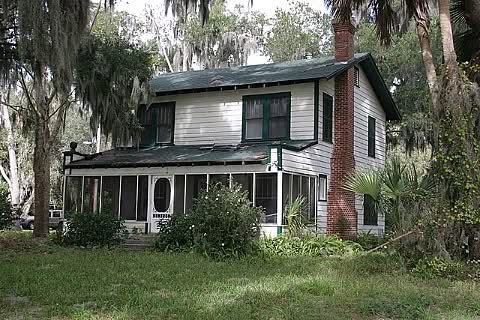
Jan. 8, 1935, a map led to the discovery of Ma and Fred Barker’s hideout. The FBI arrested Arthur “Doc” Barker for his involvement in the Bremer kidnapping, and upon searching his Chicago apartment, the FBI found a mysterious map and letter. Albright says, “On this letter and this map was Florida, a lake, and a big ol’ alligator named Joe.” The FBI immediately dispatched the information to the office in Jacksonville and went about searching for lakes in the area with an alligator named Joe. A couple of days into their search they discovered Ma and Fred Barker hiding out in a rental in the little town of Ocklawaha.
The Bradfords of Miami reluctantly rented their Lake Weir house out to the Barkers, not knowing the true identity of the mother and son duo. They were under the impression that a sweet elderly woman wanted use of the house and were given a large sum of cash in advance. Agents observed the house for a couple of days, gathering information on who was coming and going with Ma and Fred Barker. Information was sent back to FBI offices in Jacksonville and Washington, and a plan was formed.
Fifteen FBI agents were sent to the Bradford house early in the morning of Jan. 16, 1935, and surrounded the home. They walked into that day not knowing what weapons the Barkers possessed and how many people were inside the two-story home. The FBI carefully crafted an intricate map displaying each of the spots the agents would stand among the towering oaks. Metal detectors later confirmed the locations through buried shell casings left after the battle.
It was a bloody five-hour-long fight and is now known as the longest gun battle in FBI history. Estimates range from 700 to 2,000 rounds fired. Ma and Fred Barker held their ground, stealthily moving from room to room to give the appearance of several people in the home. They had guns strategically hidden throughout the house at their disposal and shot at the FBI with machine guns and buckshot.
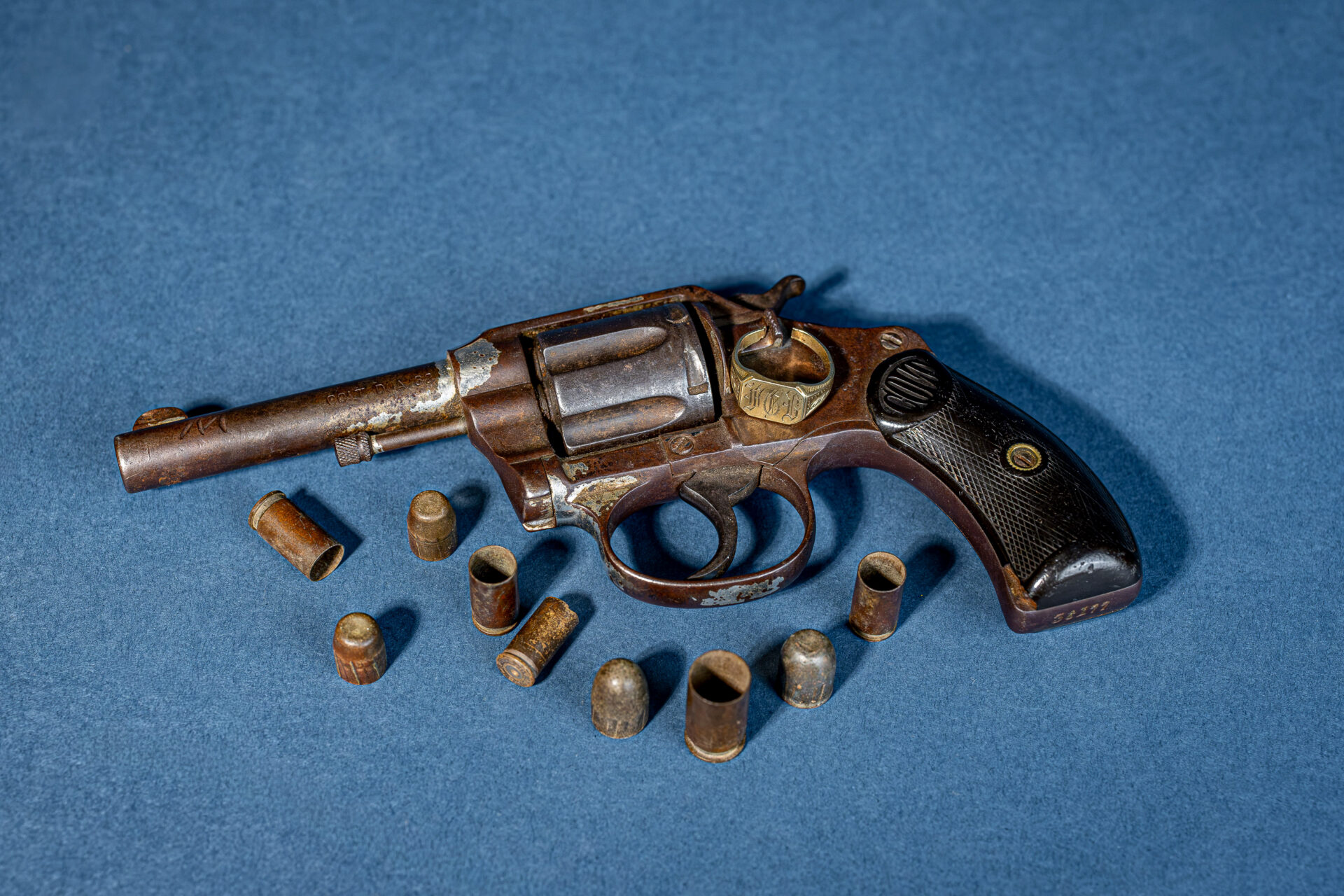
Once it was quiet within the house, the agents sent in the cook who lived next door to see if Ma and Fred Barker were dead. Fred Barker was found shot 12 times, and he had stuck cotton in each wound to keep from bleeding out. It is modern lore that Ma Barker shot herself between the eyes as a final act of resistance. She always told her boys to never let the law take them alive, and she took that to her grave. The FBI agents and civilians remained unharmed during the shootout. The criminals were dead and justice reigned.
That day a crowd of 50 spectators gathered on the edge of the property to watch the shootout. Among the onlookers was a young man by the name of George Albright Sr. He had been at the train station and heard that “all hell was breaking loose” over at the Bradford home. He quickly jumped into his car and sped over to the gunfight. He became one of the eyewitnesses of this historic event and told the story to his family through the years. His son, George Albright Jr. later went on to attend the University of Florida and became good friends with the daughter of the Bradfords, Betty Ann Bradford, and her husband, Morton Good. The Goods inherited the house and the Albrights moved next door where their sons, George Albright III and Carson Good, grew up together as childhood friends.
George Albright recalls that from a young age he understood the severity of the event that had taken place at his neighbor’s home. He heard the story from his grandfather. He saw the holes that aged with the house and sat in the furniture patched up from the bullets that left their eerie mark. Four generations used this as a summer home, resting and picnicking in a place that once was a battlefield. Where bullets once whizzed, birds now sang. Where men fought, children played. A place of beauty with a haunting past. Albright knew that this was an important piece of Marion County history that should not be forgotten, and so he and Carson Good together worked to preserve the history of the Bradford family home.
On the 50th anniversary of the shootout, Jan. 16, 1985, Albright’s father, George Albright Jr., persuaded the Bradfords to open the home to the public. This event became a part of the annual Citrus Festival that year and made the cover of the Orlando Sentinel. Albright recalls, “Next thing we know, on that day, we had thousands of people show up in the middle of Ocklawaha. And they waited hours in line to walk through the house.” They raised $10,000 on that one day alone. Albright saw that the house would always be relevant because of the interest people have in learning about the gangster era during the Great Depression.
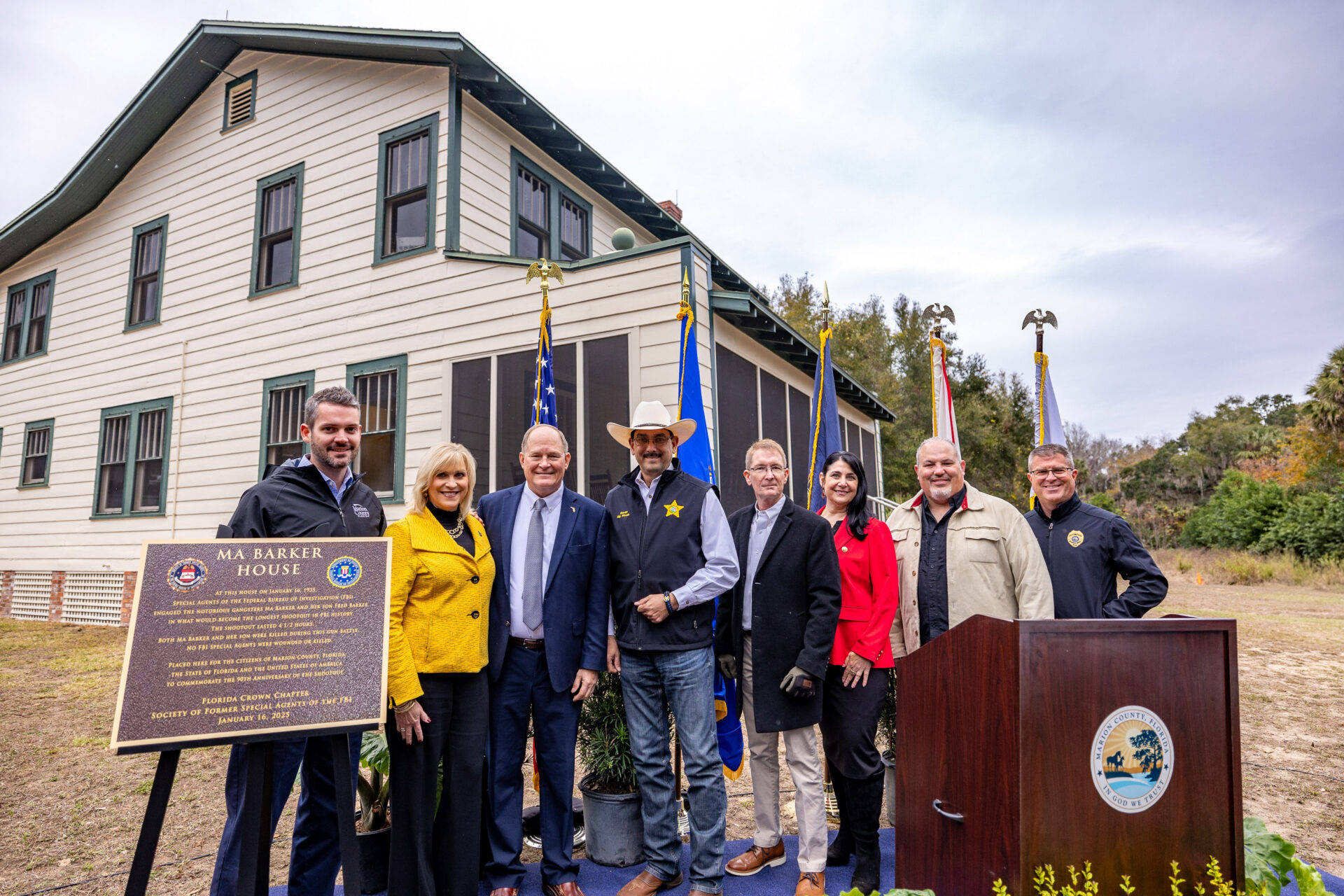
In 2014 the family started the process of selling the property with a past. However, no one wanted the home because of its murderous beginnings. In 2016, however, the property was to be sold and the historic home to be demolished. Albright remembered the attention the house received in one day alone back in 1985 and began formulating a plan.
“So I thought to myself, ‘let’s see if that interest is still there,’” Albright recalled. With the clock ticking on the sale of the property, he went to Marion County commissioners with a plan up his sleeve. He proposed to the county that if they moved the Bradford home to another property, the family would donate the house and all its contents to Marion County as a charitable cause. The reminder of the FBI agents’ bravery and success should not be torn down and forgotten but rather acknowledged and preserved.
All five commissioners were intrigued by the idea. In early summer 2016 Albright and Good decided to open the home once again to see if the community would come together. They gave just five days’ notice on two Facebook pages that the house would be open to the public for the day. The county commissioners and the county administrator showed up the day of the opening and were astonished by the turnout. Albright shared that 1,000 people from the community showed up. “I counted them physically myself.”
The property was overflowing with people of all ages to see the historic home. It was a day the commissioners would not easily forget. “Their eyes were so big,” Albright says, “they couldn’t believe what they were seeing!” They saw the value the Bradford home had for the community “as a lasting legacy of Marion County history.”
From there, Marion County, Albright, and Good moved rather quickly. With the days counting down to the property officially being sold, they had to act fast to move the home. The county spent approximately $252,000 to move the home to Carney Island Recreation and Conservation Area on Lake Weir. However, to do that the house would have to be cut in half, canopying oak trees would have to be torn down and power lines temporarily removed. The costs would have easily surpassed $1 million.
Not one to be afraid of a challenge, Paul Stentiford, owner of Stentiford Construction, rose to the occasion. “All the other builders refused to do this project and we don’t shy away from a challenge. We like unique and interesting projects and this is one of them,” said Tyler Stentiford, son of Paul Stentiford. The house was to be floated across the lake to its final resting place, a feat no one else was willing to chance. Preparation for the move took 26 days. Stentiford called in Youngblood House Movers as a subcontractor for their expertise and help with the massive project.
Down to the details, every part of it had to be precise and calculated. They had to raise the house, roll it down to the water onto a bridge of steel, and onto a 40-by-80-foot pin barge. It was a massive undertaking that was executed by a team that truly cared about the work they were doing.
When the day finally came in October 2016, it was smooth sailing for the Bradford home. Civilians came out on their boats to watch and cheer on the 30-minute trek across the water. It was “really cool that we were a part of that history where the FBI apprehended those criminals,” Paul Stentiford shared. The Stentifords found themselves in a comparable position. They apprehended the house, but this time, the house met a much better fate. The home made it in one piece without any bumps along the way.
The Bradford home, now a museum, opened for scheduled tours a few months later. But the story does not end there. Now, 10 years after the house was floated across Lake Weir, Albright said there are plans to build an interpretive center. This would open the opportunity for all to visit as it would be ADA compliant. “We want to preserve the house and at the same time maximize the ability for people to come and see it,” Albright said. “You may not be able to go into the house but you can do the interpretive center.”
The interpretive center would also help minimize the wear and tear on the 96-year-old home. The idea is to replicate the experience of the home within the interpretive center and educate visitors on what exactly took place, such as through a movie. There are also plans to plant the exact same trees in each spot the 15 FBI agents stood under to try to help immerse people in what the property looked like in the day and time of the shootout.
Private funding is being raised and preparations are underway; the Ma Barker house is not finished yet. The crime may have ended that fateful day in 1935, but the house stands strong and lives on. Albright, Good and Stentiford have also made history alongside the home and are continuing to do so with their efforts and plans for the future. When the community rallies together to keep alive their history, it is something to take pride in. It may be a house with a dark past, but the community is eager for what lies ahead in the small town with an alligator named Joe.