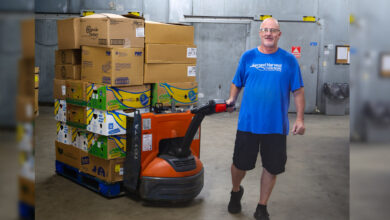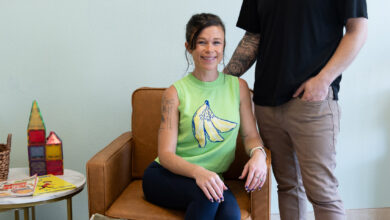

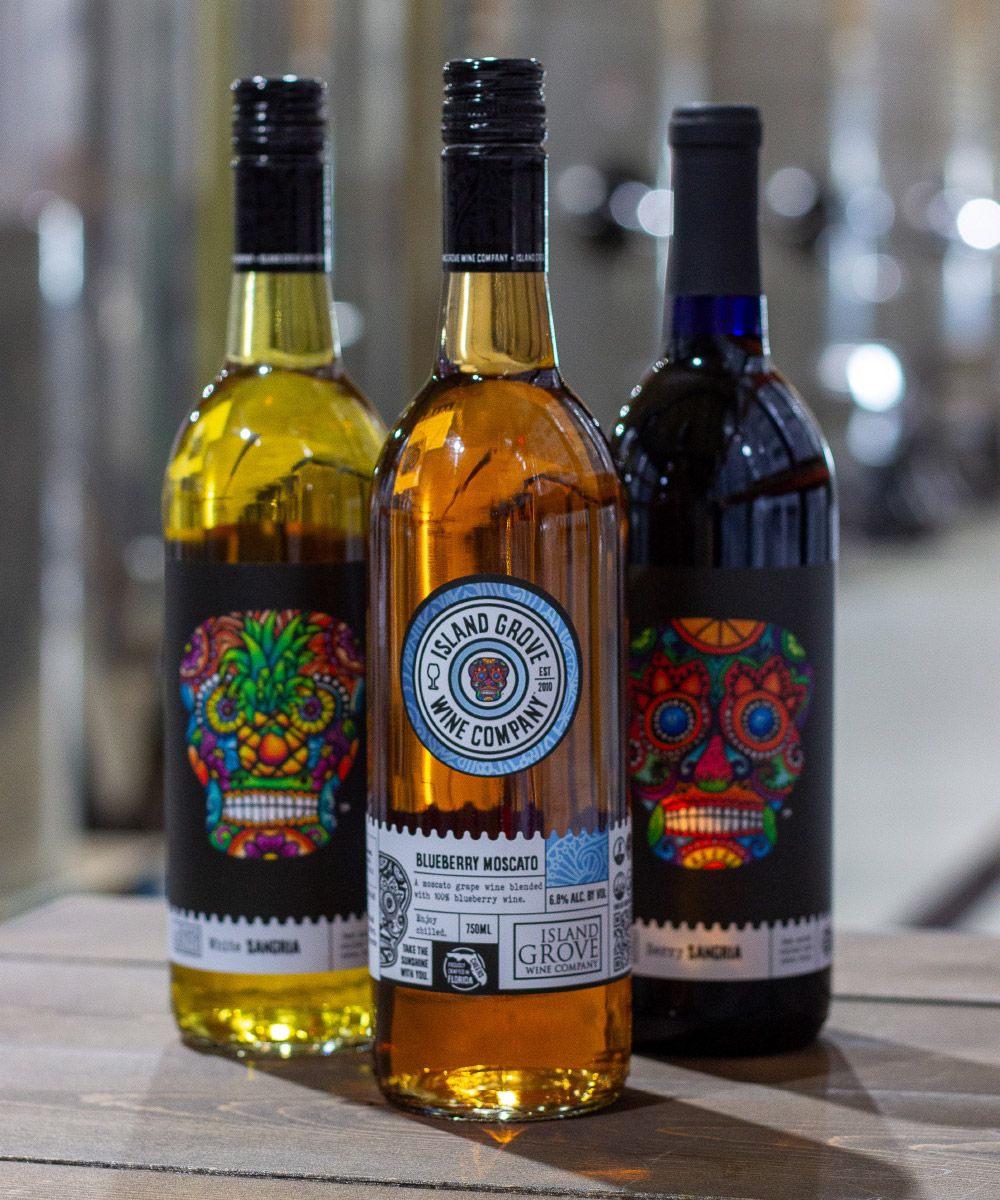
For speeders heading north from Ocala on U.S. Highway 301, the hamlet of Island Grove passes by in a quick minute. Yet it’s well worth slowing down at the large, colorful skull sign to visitIsland Grove Wine Co. for a taste of Florida’s agricultural future amid decidedly Old Florida vibes.
Island Grove’s tasting house is less than four miles east of the area’s most famous attraction: the homestead of author Marjorie Kinnan Rawlings, who wrote The Yearling and other books from her orange grove near Cross Creek in the 1930s and ’40s. The tasting house also doubles as a vintage shop, meaning that beside the contemporary bar styled with trendy whisky barrels and blue-bottle chandeliers are shelves of antique dishware and furniture, much of it dating to Rawlings’ era.
This decorative juxtaposition of old-meets-new also speaks to what Island Grove, LLC—the multi-family-founded operation that encompasses the winery—aims to achieve more broadly. In this near-ghost of an Old Florida farm town, Island Grove is producing science-backed varieties of a relatively new-to-Florida superfruit.
Before we talk more about the blueberries, though, let’s start with their terroir.
The once-thriving small town of Island Grove began with a fair amount of promise. According to Alachua County historical records, Island Grove was established in 1884 and so-named because it was a fertile place for orange groves “surrounded” (broadly speaking) by bodies of water, including Orange Lake, Lochloosa Lake, and various creeks. With a population peak of around 400 people, Island Grove had its own train depot, moss factory, and cigar maker. It also boasted a Masons Lodge, post office, and shipping center for citrus and other vegetables.
Then, a series of hard freezes in the 1890s abruptly ended many of the orange groves. The other industries gradually disappeared, too, and the population dwindled to less than a couple of hundred people. Now, Island Grove is an unincorporated community. Other than the paved county and state highways that bisect it, the roads are mostly sugar sand or overgrown.
Yet a small core of residents has preserved portions of the town’s origins, including several well-maintained cracker-style houses and a recreated vintage Standard Oil service station. Advocates even successfully fought for the Masons lodge to be listed on the U.S. National Register of Historic Places.
In the early 1990s, a newcomer from Naples, Florida, arrived in Island Grove. Ken Patterson was looking for a change of pace and blueberries were a trendy, albeit challenging, crop spreading across Florida. His family purchased a 40-acre parcel of land and started growing. Literally. Within a few years, Patterson merged his operation with another nearby blueberry farm, owned by the Strang family from Winter Haven. The consolidated operation became Island Grove, LLC, which now owns hundreds of acres in Alachua, Marion, and Putnam Counties.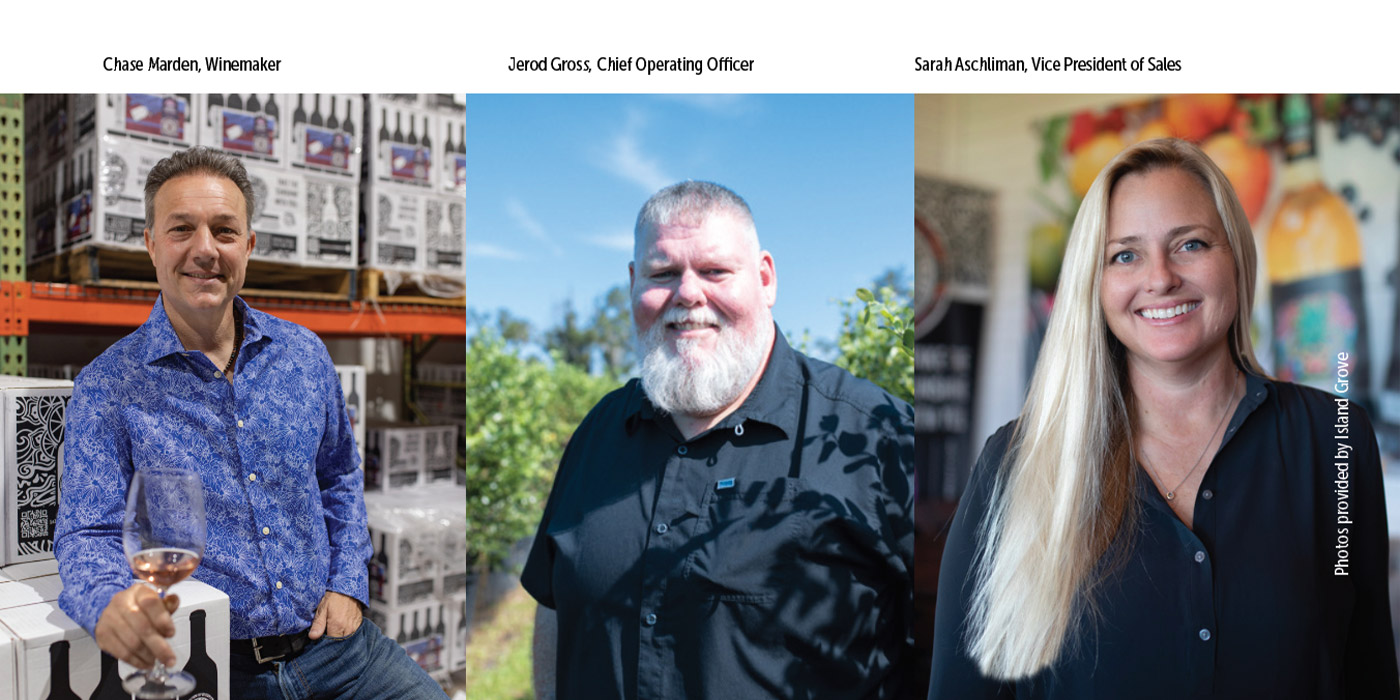
The Science of a Superfruit
Early on, the founding Island Grove farmers partnered with scientists at the University of Florida Institute of Food and Agricultural Science (UF/IFAS) to develop new varieties of Southern Highbush blueberries, the only kind of commercial blueberry that can tolerate Florida’s mix of hot summers, short winters, and high humidity.
For the past ten years, Associate Professor of Horticulture Patricio Muñoz has been their primary research partner. As head of UF/IFAS’s Blueberry Breeding and Genomics Lab, Muñoz works closely with Island Grove and other commercial blueberry growers in Florida to test new varieties and breed for specific traits, such as plants that bloom early and produce high-quality fruit firm enough to tolerate machine harvesting.
Wild blueberries are native to the United States and generally produce berries that are small and flavorful, yet somewhat fragile. In 1911, a USDA botanist and a cranberry farmer in New Jersey teamed up to domesticate the wild blueberry for the first time, meaning they were able to cultivateconsistent plants with predictable berries. Then in the 1950s, University of Florida Horticultural Professor Ralph Sharpe adapted the New Jersey blueberries to the southeast by hybridizing them with a wild variety in Florida, which doesn’t require a long winter to fruit. The result was a variety named Sharpblue that the university released for commercialization in 1976, which launched the modern blueberry industry in Florida.
Since then, UF/IFAS has bred dozens of commercial varieties. In January, the team named one of their newest varieties “Sharper” in honor of Sharpe’s legacy and the 50-year anniversary of Sharpblue’s release. Sharper blueberry plants fruit early and have high yields, with large, crunchy berries. Muñoz says that growers are already telling him the variety could be a game-changer for many farms.
However, the goal isn’t to produce one single, perfect blueberry monocrop. During our interview in April, Muñoz held up chilled samples from twelve test varieties to show their range in terms of size and color, adding that he’d also picked and tasted berries from roughly 150 plants in the field earlier that day.
“It’s an amazing crop. Blueberries have a huge variability, so we could push into larger blueberries, crunchy blueberries, healthier, or more flavorful,” he says. “And we are doing all of that. We are pushing in all these different directions. You can have flavors that are more like raspberry or peach or tropical flavors. You can have textures that are amazing, more crispy, or very juicy. Blueberries are just going to get better over time.”
Island Grove serves as a test site for many of these new varieties, and the growers offer feedback to Muñoz’s team about the performance of the plants. When new varieties are ready for commercialization, Island Grove is able to license them to not only grow berries but also to propagate plants to sell to other commercial growers. Today, Island Grove’s nursery division is one of the largest blueberry nurseries in the southeast, and it’s the largest component of Island Grove, LLC.
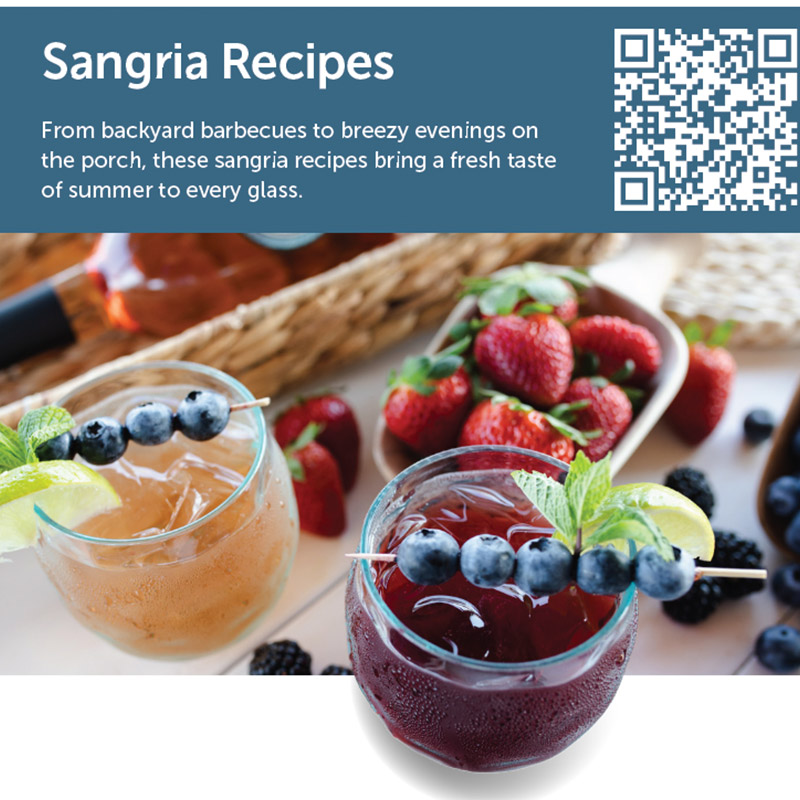
Fresh berries are also still important for the company. For years, Island Grove lost money on fresh berries that were too soft or cosmetically imperfect to package in clamshells and sell in grocery stores. To make metaphorical lemonade from this production lemon, the founders met with winemaker Chase Marden and decided to turn the less-pretty berries into wine. In 2010, Island Grove Wine formally launched with two all-blueberry wines, one dry (called Kinda Dry) and one sweet (called Sorta Sweet). The line-up quickly expanded to include blended wines and sangrias made from other regionally sourced fruits, such as blackberries, peaches, and strawberries.
Sarah Aschliman is the vice president of sales for the winery and attributes its steady success to the quality of the source berries. Island Grove initially grew conventional blueberries, but in recent years has converted all of their fields to fully organic. “When you start with a really good fruit, you’re going to have a good wine afterwards,” she says. “We’re picking really good, quality blueberries here, and we love them. It transfers over to the wine, for sure.”
Behind that love is a little science, too. A study by the University of Florida in 2012 tested the antioxidant properties of wines produced by Island Grove. Researchers found that compared to white and red wines made from grapes, the wines made from Southern Highbush blueberries contain a comparable level of antioxidants to red wine—and contain more antioxidants than white wine.
Aschliman has become a well-known advocate for Florida wineries, which sometimes means crossing paths with state legislators. The winery team was active in the effort last year to change state law to permit recyclable wine containers, which now allows alcohol producers to take advantage of newer and more sustainable packaging options. Sen. Tom Leek (R-St. Augustine) sponsored the recyclable alcohol packaging after listening to Island Grove and others. Since the statue went into effect last summer, Aschliman anticipates increasing demand from restaurants for Island Grove wines.
In addition to championing blueberry wines, Aschliman is also the president of the Florida Wine and Grape Growers Association. “We try to promote [muscadine] grapes and Florida wine, which comes from all kinds of fruit,” she says. “We’re making wine that is not traditional. We’re not growing it in a growing region of France or California or Oregon or somewhere that is known for their soil and weather. But people like trying something different and local, and we’re handcrafting all kinds of different things that are coming right from Florida.”
A Season to Support
At Island Grove, Chief Operating Officer Jerod Gross oversees all day-to-day operations at the berry farm, nursery, and winery. He also doubles as an elected member of the DeSoto County Commission and is passionate about speaking up for Florida farmers. He’s especially conscious of the aging demographics of farmers and the issues preventing newcomers from getting into the industry.
Gross, who married into an Island Grove founding family, worked in the construction industry until 2009, when he and his wife decided to try running their own blueberry farm instead. They partnered with Aschliman and her husband to open “the cousins farm.” Gross was a fast learner. “We had a pretty good run until Irma wiped us out,” he says, and in 2020, the Island Grove founders invited him to take over all operations and become part of the senior management team.
Island Grove’s diversified success is notable in the blueberry industry because the crop is still fairly niche in Florida. For context, blueberries currently take up around 5,500acres statewide. Oranges, by contrast, occupy almost 184,000 acres—though Florida’s most iconic fruit is rapidly losing ground, thanks to citrus greening disease and urban development. Currently, fewer than 1,000 acres are still dedicated to citrus in Alachua and Marion counties, combined.
However, even the biggest champions of Florida blueberries don’t think all those acres will convert into berry fields anytime soon. “There are still a lot of people trying to save the citrus industry, and it’s going to be multiple crops that perhaps go into helping to make up for what citrus leaves behind,” says Muñoz.
Gross estimates that the cost to convert an acre of an existing farm into blueberries is around $30,000, and the figure spikes to $80,000 per acre if an aspiring farmer doesn’t already own land. Those upfront costs are combined with the state’s severe farm-labor shortage and frequent weather disruptions. “It’s hard work,” Gross says about farming. “It’s a lifestyle, and I wouldn’t trade it for nothing, but it can beat you down at times.”
In particular, 2026 has already been near catastrophic. Blueberries were hit especially hard by the long-lasting freeze in February, followed by central Florida’s most severe drought in fifteen years this April. In response, Island Grove has cancelled its 2026 Blueberry Festival, and Aschliman says blueberry producers statewide are looking at a 50 percent loss in fresh berries this season.
Yet despite the challenges, Muñoz and Gross both say it’s crucial for Florida farmers to persevere. Florida’s growing season starts the earliest of anywhere in the continental United States, and Florida growers specialize in the vegetables and fruits that are lacking from the diets of too many Americans.
“We have to be dependent on ourselves to provide our own food and not be dependent on somebody else bringing us food,” Gross says. “Agriculture has to be viable in Florida for many, many more years. The only way we can do that is by being a strong voice, trying to protect what we have, being good stewards of the land, and really focusing on how do we better improve our production and opportunities.”
Florida consumers can help by making an effort to buy locally grown blueberries whenever possible while the berries are in season, Aschliman says. “Look for the Fresh from Florida sticker in the grocery store.”
For Aschliman, the effect of consumer choice on farm families is especially personal, since Patterson is her father. “Being a farmer’s daughter, I will all day long say, buy Florida produce, buy local Florida, go to the U-pick farms, support what you can. Be there at the farmer’s markets on the weekends,” she says. “It means the world to those families that are working so hard to provide.”
Sandra Barnidge is a freelance writer based in Gainesville. She covers science, arts, and culture for a range of publications. She’s also the author of The Diamondbacks, a novel about sports and religion in the South.