
A Gainesville girl at heart, Darianne Schramm is finding literary success while making her home halfway around the world.
Of all the things she misses most about her home state, author Darianne Schramm says Florida thunder tops the list.
From her new home in Christchurch, New Zealand, Schramm says she’s learned a surprising thing: not all thunderstorms are created equal. “[The thunder here] does not sound normal. It’s like the quietest sneeze of thunder,” she says. “I miss that every summer day in Florida at 2 p.m., your house is just getting rattled by thunder and rain, and then twenty-five minutes later it’s over.”
Though the weather may be calmer in New Zealand, Schramm herself is taking the literary world by storm this fall with the release of her debut YA novel, 72 Hours of You, published in the United States by Disney Hyperion. After a bidding war between three major publishers in the United States and four in the United Kingdom, the book is now slated for release in fourteen different countries. Additionally, her debut adult novel will publish in 2028, with another YA novel right on its heels and a second adult novel under contract. She also recently signed with a television and film rights agent.
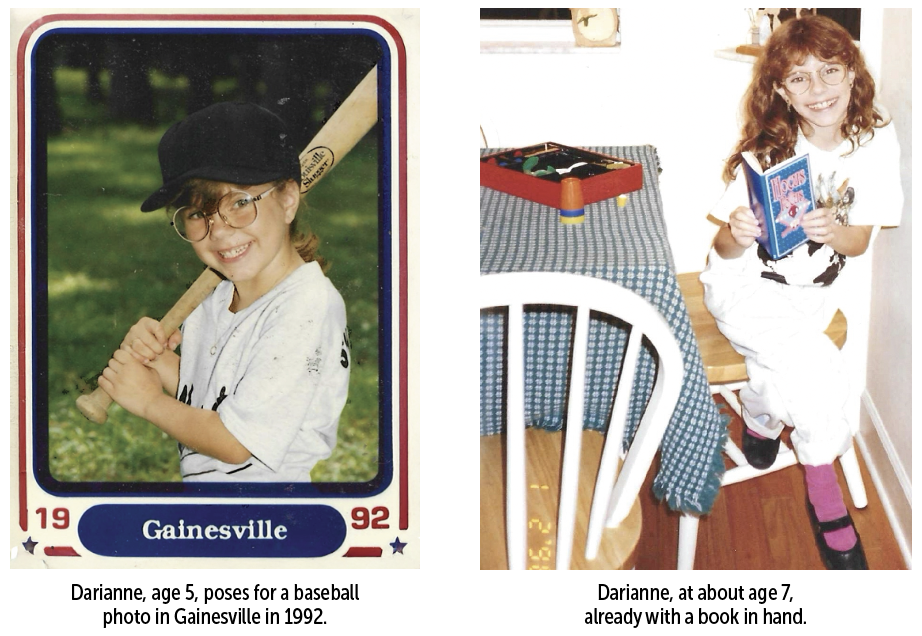
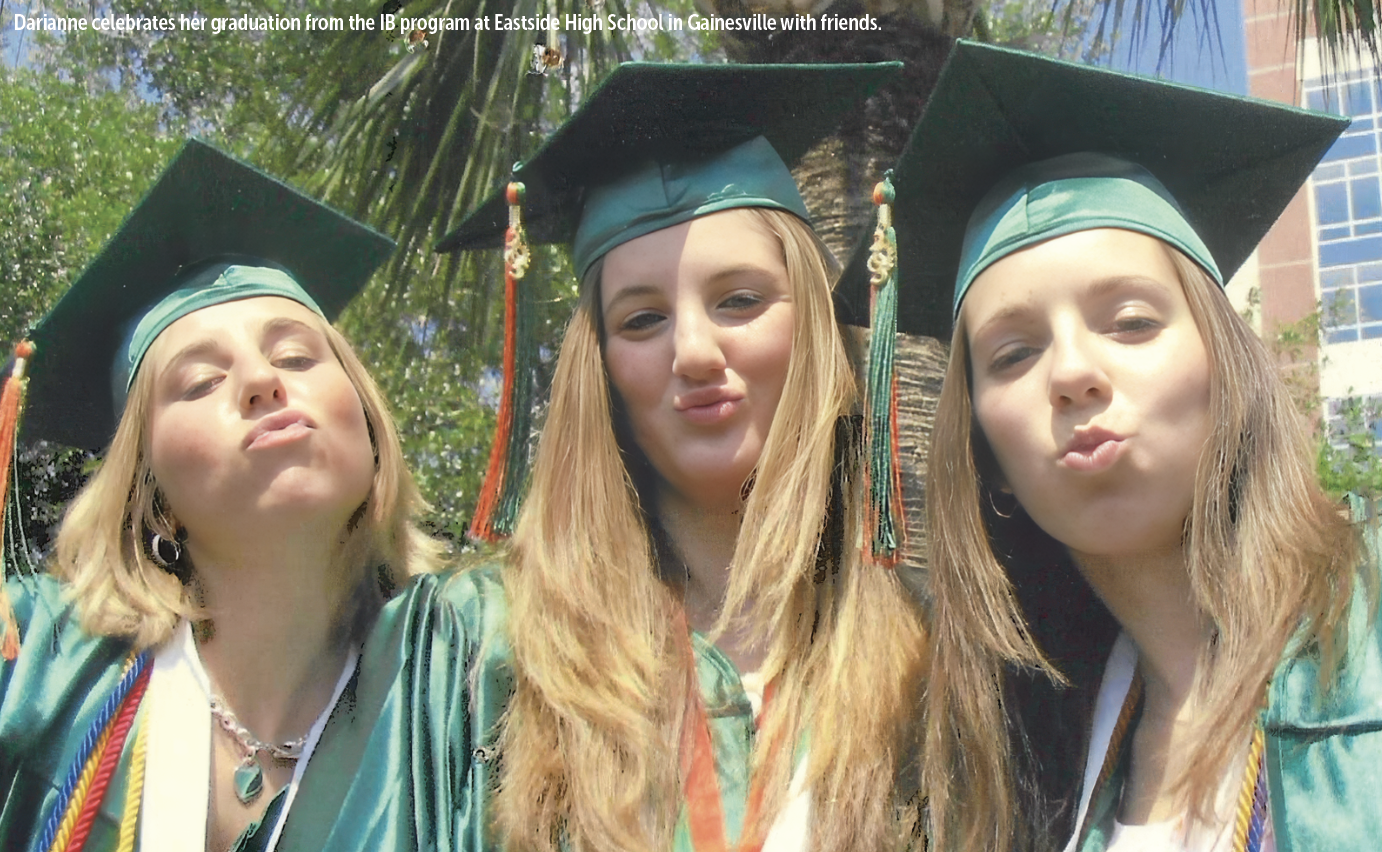
For any author, getting one book produced by a major publisher is a lifetime achievement. To have four in such quick succession is jaw-dropping. Yet behind every “overnight success” is, of course, decades of unseen work. For Schramm, the road to becoming a New Zealand-based author began in Gainesville, where she grew up in a house in the woods, listened to Tom Petty songs, and skipped more than a few of her classes at Eastside High.
“I think Gainesville in general is a hub for creativity,” she says. “I feel like there’s something magical in the water there.” Schramm, too, was a creative kid, with an early appreciation for literature. “Some parents encourage you to be a doctor or a lawyer. From the time I was little, my mom was always like, ‘You should write a novel. You should be an author. I could just see this in you,’” says Schramm. “And I was like, ‘No, Mom, I can’t. What are you talking about? I could never do that.’”
Instead, teenaged Schramm was drawn toward philosophy and trying to figure out life’s biggest questions with her friends. She and one friend in particular would spend evenings driving around Gainesville, sometimes stopping to eat at Texas Roadhouse. “Then we would just sit in the parking lot for hours and indulge in the pleasure of talking to each other with some music on until 2 a.m.”
Usually, that music was Tom Petty. “I am a huge fan of Tom Petty. I don’t even know if fan is the right word,” she says. “I feel like Tom Petty has been so instrumental in my life in so many different ways.”
In homage to that connection, let’s give this profile a soundtrack.
“Runnin’ Down a Dream”
After graduating high school in Gainesville, Schramm majored in philosophy at Elon University in North Carolina and then felt a deep, somewhat inexplicable pull toward California. “I think part of it was because Tom Petty was always singing that’s the place where all the magic happens,” she says. “And I think he transformed California in my mind into this magical formative place where you can go and be creative and find yourself, which I did.”
She earned a master’s degree in liberal studies from the University of Southern California, where she convinced a somewhat reluctant committee to allow her to write her thesis on Tom Petty’s lyrics. “To me, his music is about being an outsider, but it’s also about believing in yourself and being okay with coming to terms with being an outsider and owning who you are,” Schramm says. “And I feel like having that voice in the back of my head has always been a real comfort and an inspiration.”
In California, Schramm met her husband and had a daughter, and she began writing for magazines in addition to her academic work. Then, the COVID-19 pandemic brought their world to a standstill. She remembered her mother’s early encouragement to write novels. “I thought, well, everyone is trying to live their dreams right now or bake banana bread. I could try. I could just try and see what happens. And so I did.”
Schramm wrote a middle-grade novel, obtained a literary agent, and sent the book to publisherg©s. It was rejected, and Schramm decided she wanted to try something different. “I really had nothing to lose [I thought], so what if I just write this book that I really, really want to write and just see how that goes instead?”
Her second manuscript became 72 Hours of You. It’s about a girl named Sydney who has the magical ability to see a pink neon clock begin to count down above someone’s head seventy-two hours before their death. Her gift has made her cynical, but then Sydney meets a boy named Peter who convinces her that seeing the clocks might not be the worst thing in the world.
For much of the book, the two main characters skip school to meet up, eat pizza, and talk to each other about life, death, and philosophy—and they fall in love along the way. Schramm wanted to recapture the intensity of feelings she remembers from her own nights in the Texas Roadhouse parking lot. “Romance as a teen is just a completely different feeling. It’s that all-consuming, nothing else matters kind of feeling. It’s just you and me.”
The death clock apparition was inspired by Schramm’s own dark thoughts during the pandemic. “I felt like I could see clocks over people’s heads. I was like, we are all going to die and how do I live feeling like we’re all going to die? And I think that this book was a meditation on [that experience, which] I call pre-grief, when you are just sitting in grief over something that has not happened yet and might not happen, but the worry and the anxiety over something bad happening is just so all-consuming that it changes how you interact with the world around you. How do we still live a meaningful life with the sickle over our head?”
“To me, I hope this is the kind of book where you’re crying, but you’re also holding the book against your chest and being like, okay, it’s all going to be okay. There will be tragedies in life. We don’t need to lie about that. And there’s always, always a way forward, and there is always hope to be found no matter how dark it gets.”
“Southern Accents”
The manuscript for 72 Hours of You sold quickly and spent the next two years meandering its way through the publishing process. In the meantime, Schramm realized she was ready for yet another change of scenery.
In 2025, she and her husband decided to move to New Zealand in search of a more low-key lifestyle. They found friendly people, a walkable city, and an education system that prioritizes outside time for their daughter. Schramm’s parents, along with her brother’s family, also emigrated with them. Coincidentally, on the day of her interview with OM, Schramm received her official permanent resident card.
Though she loves New Zealand, Schramm says, “I’ll always be a Florida girl, almost even more so now that I’m not living there. It’s kind of the same as Tom Petty. He was always saying, ‘Hey, we’re a California band,’ and then used Southern accents, which is an ode to Florida. The Florida roots never leave you.”
Before the big move, Schramm returned to Florida to say goodbye. On their last night in the United States, she and her husband went out to St. Augustine Beach and watched the heat lightning crack over the ocean. “It just made me so emotional,” she says. “This is Florida, and this is home.”
“Time to Move On”
On the day 72 Hours of You published in the United Kingdom, Schramm lost one of her favorite diamond earrings, which she’d worn regularly for a decade. Her daughter—who as a younger child would sometimes hesitate to wear a new necklace or play with a favorite toy because she was afraid something bad might happen to it—asked Schramm if she was upset.
Schramm remembered the advice she used to give her daughter about overcoming the anxiety of what if something bad happens. “If you don’t wear it, if you don’t use it, it might as well already be gone.” This way of learning to cope with “pre-grief” had also evolved into a major theme in 72 Hours of You, so for Schramm, the missing diamond didn’t feel like a coincidence.
“I wore the earring every day for ten years and now it’s gone, but I still got to wear it, and I still got to enjoy it, and that was better than having it in a box for ten years,” she says. “It felt very auspicious that I lost it on publication day. There is something just so metaphysical here in that lesson, that you continually have to learn all of the time.”
As 72 Hours of You finds its way to readers this year, Schramm is turning her attention to her upcoming projects. She’s completed edits on her adult novel, The Eternal Deaths of Hattie Gold, which will come out in early 2028. It’s about a Gen Z-aged girl who is in training to become the next Death. Her mentor, Millennial Death, says the girl must kill the one human boy she’s ever loved in order to take up her role. Schramm’s follow-up YA novel is titled Kiss Me Like the Last Time. It’s about a girl who, when she kisses someone for the first time, is able to see that person’s last-ever kiss at the same moment.
Both upcoming books, like 72 Hours of You, are existential stories about love, time, and, of course, death. One of the common links between the projects is their accessible way of exploring nihilism, which for Schramm takes two forms. “One is, nothing matters. And the other is, hey, nothing matters, so we may as well go out and live the life we want to live. And all things can be true because life is always changing every day, every minute, every hour. So I think it’s okay to change your philosophy on the daily, depending on how it’s going.”
Nihilism has also helped Schramm learn to live with one of her life’s biggest contradictions: the farther away she gets from Florida, the more clearly she sees her home place. “When I first moved to Los Angeles, I kept thinking, ‘What is wrong with the sky? It’s not even the right color here.’ In Florida, the sky is that special kind of blue with those white puffy clouds. You don’t get that everywhere,” she says.
“You don’t realize how special the Florida sky is until you’re not looking at it anymore.”
We bet Tom Petty would be proud.