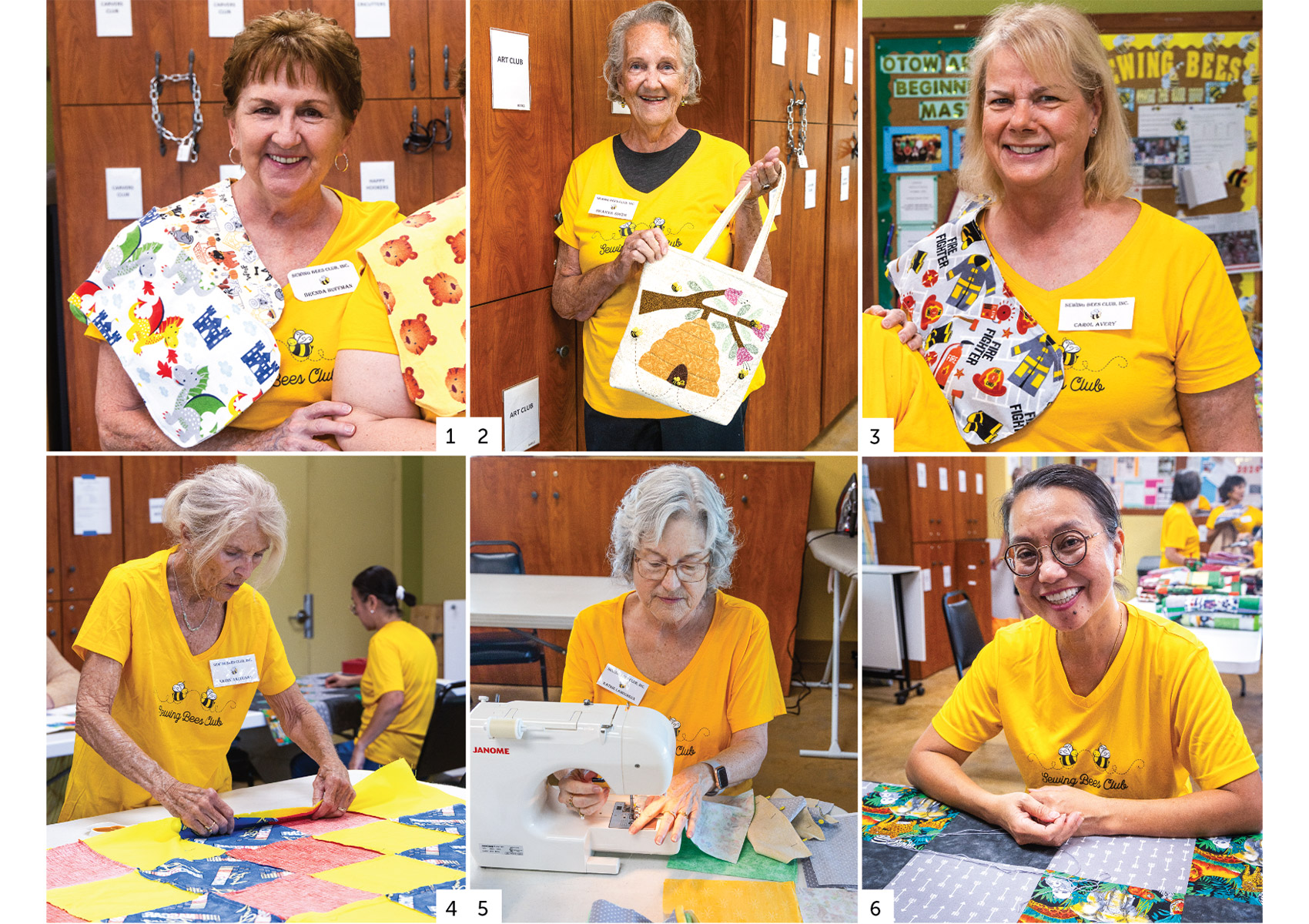

For women living in a 55-plus community, Gallo said sewing for children can fill a space in their own lives, too.
Walk into the hive at On Top of the World on a Thursday afternoon, and the name the Sewing Bees Club suddenly makes perfect sense.
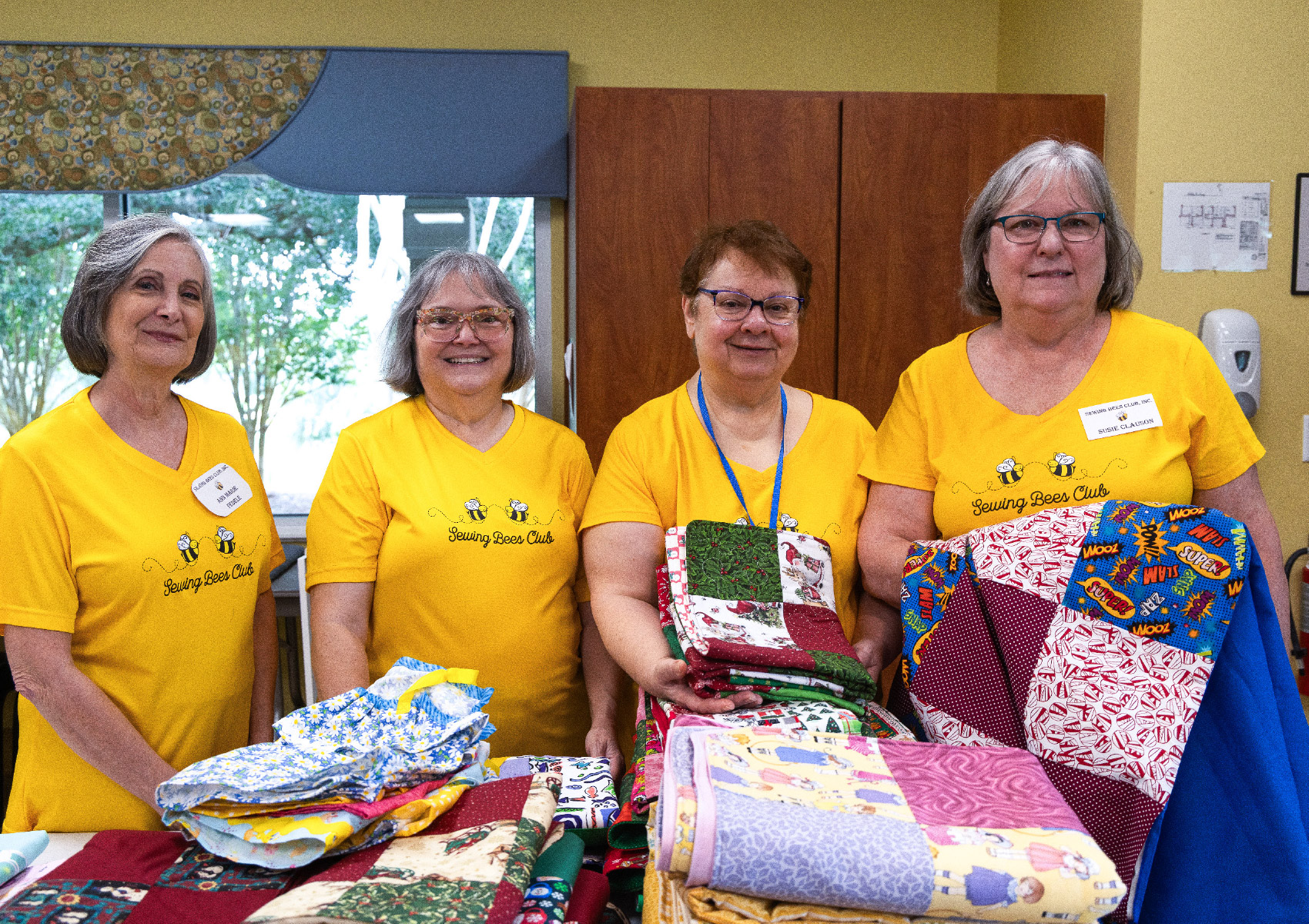
Dressed in bright yellow shirts, women talk and laugh as they work, each with a role in turning pieces of fabric into something that will eventually bring comfort to a child they may never meet.
Ann Marie Fedele, the club’s secretary, walked me through the process. It begins with donated fabrics that are sorted and coordinated by color and pattern. One member cuts the pieces. Another sews them together. From there, the work continues through different hands as the quilt takes shape.
Member Carole Avery taught me something I didn’t know: A quilt has three layers — the top, batting and backing.
At the hive, those layers and all the work that goes into them may pass through several sets of hands before becoming one finished quilt.
Like busy bees, everyone has a job, and every set of hands contributes to the finished product.
For member Kathie Lamoureux, the appeal of the work is simple.
“Something we love to do, but doing it for someone else,” she said.
And they do a lot of it.
The Sewing Bees Club has been serving the community for more than 35 years and became a 501(c)(3) nonprofit in 2023. Its 54 members, all residents of On Top of the World, make quilts, blankets, clothing, burp cloths, Christmas stockings and other items that are donated to children in need.
In 2025 alone, the group completed 1,193 quilts and about 150 Christmas stockings. Ann Gallo, the club’s president, estimates the Sewing Bees go through nearly 4,000 yards of fabric each year.
Gallo is constantly looking for organizations that could use what the women make.
“I’ll read a newspaper article and I’m like, ‘Oh, let me check out this agency,’” she said. “I’ll reach out to them and tell them what we do and, like, what do you need? How many do you think you could use?”
Their work reaches children through organizations including the Marion County Children’s Alliance and Reddick-Collier Elementary School, as well as young patients receiving intensive care through AdventHealth and UF Health Shands Children’s Hospital. Those are only a handful of the schools, hospitals and nonprofit organizations that have received items made by the Sewing Bees.
For some children, Gallo said, a handmade quilt may be one of the few things they have that was made especially for them.
“It’s warmth. It’s comfort,” Gallo said.
Sometimes, the women get to see what happens after their work leaves the hive.
At Reddick-Collier, children have been photographed holding their quilts, made flowers for the women and even recorded videos singing to them. Gallo said the cards, photographs and messages the club receives are eagerly shared among the members.
“The ladies just eat this up,” she said. “Every time we get a letter or card or something and we show it to them, they get so excited.”
Treasurer Rolanda Jacobovitz has also heard from an educator at the school about an impact that extends beyond the gifts themselves. She said the children are being taught to recognize that someone they do not know intentionally made something for them, helping them understand generosity and gratitude and encouraging them to someday extend that kindness to someone else.
Sometimes the impact lasts far longer than anyone could have anticipated.
Gallo recently experienced that firsthand after mentioning to doctors at UF in Gainesville that the Sewing Bees donate quilts to the NICU at UF Health Shands Children’s Hospital. A fourth-year doctor approached her and shared that she had been a NICU baby herself in New York and had received a handmade blanket while in the hospital. Her family kept it, and part of the blanket remains framed in her home 35 years later.
Vice President Susie Clauson later reflected on Gallo’s encounter.
“It was so heartwarming to hear about the lasting love this had provided,” Clauson said. “As we are currently working on NICU and PICU quilts, this was very encouraging to hear.”
The story is a reminder that something made during an ordinary Thursday afternoon at the hive can become part of someone else’s life for years.
But the giving inside this room goes in more than one direction.
The club’s members range from women in their 50s to their late 80s, and a 101-year-old member was still tying quilts until health issues prevented her from regularly attending. Another member continued sewing from assisted living until age 100, with fabric brought to her and completed quilts returned to the group.
For women living in a 55-plus community, Gallo said sewing for children can fill a space in their own lives, too. Many have grandchildren who live far away. Others, including Gallo, do not have grandchildren.
“For them, it’s almost like making a quilt for their grandchild, even though it’s not their grandchild,” she said.
And keeping up with nearly 1,200 quilts a year requires a staggering amount of material — and somewhere to put it.
Storage is one of the Sewing Bees’ biggest challenges. Cabinets at the hive are packed with fabric and supplies, and when the possibility of having additional space came up during my visit, the women lit up. For them, more room wouldn’t simply mean more storage. It would mean being able to do more.
Gallo knows the problem particularly well.
After the club purchased 100 rolls of the specific batting it uses for its quilts, much of it came home with her.
Fifty-eight rolls of batting are stacked in the shower stall of her second bathroom.
She has the photograph to prove it.
Additional batting is stored in her sunroom and garage. Gallo said even a small, climate-controlled storage space would make a difference.
The club also relies heavily on donated fabric and financial contributions. Among its most-needed items are extra-wide quilting cotton for backing, children’s and infant-print cotton fabric and flannel, 80/20 batting and rotary blades. Financial contributions allow the Sewing Bees to purchase batting and other supplies needed to keep up with the demand.
Donations from the wider community are welcome, although membership in the Sewing Bees is limited to On Top of the World residents. The club can be reached at SewingBeesClub@gmail.com or through its Sewing Bees Club Facebook page.
Still, somehow, the fabric keeps arriving, the cabinets keep filling and the women keep sewing.
And every Thursday, inside the hive, dozens of individual contributions come together: three layers, many hands and one quilt destined for a child who may never know the names of the women who made it.
The Sewing Bees may not always get to see where their work ends up. But sometimes a photograph comes back. Sometimes it’s a handmade flower or a child’s song. And sometimes, 35 years later, a piece of one of their quilts is still hanging on someone’s wall.